Worried Your Child Might Have ADHD? Here’s What Parents Should Know

If you’ve ever found yourself Googling things like:
“Why can’t my child focus?”
“Why does homework take hours?”
“Could this be ADHD?”
“Is this normal behavior?”
…you’re not alone.
Many parents notice signs long before a teacher, pediatrician, or therapist brings it up. You may see daily struggles that don’t fully make sense, even when your child is bright, creative, and trying hard.
At Lotus Bloom Psychology, we talk with parents every day who feel stuck between “maybe they’ll grow out of it” and “I think my child needs support.”
That uncertainty can feel overwhelming.
That’s exactly why we created our free downloadable guide:
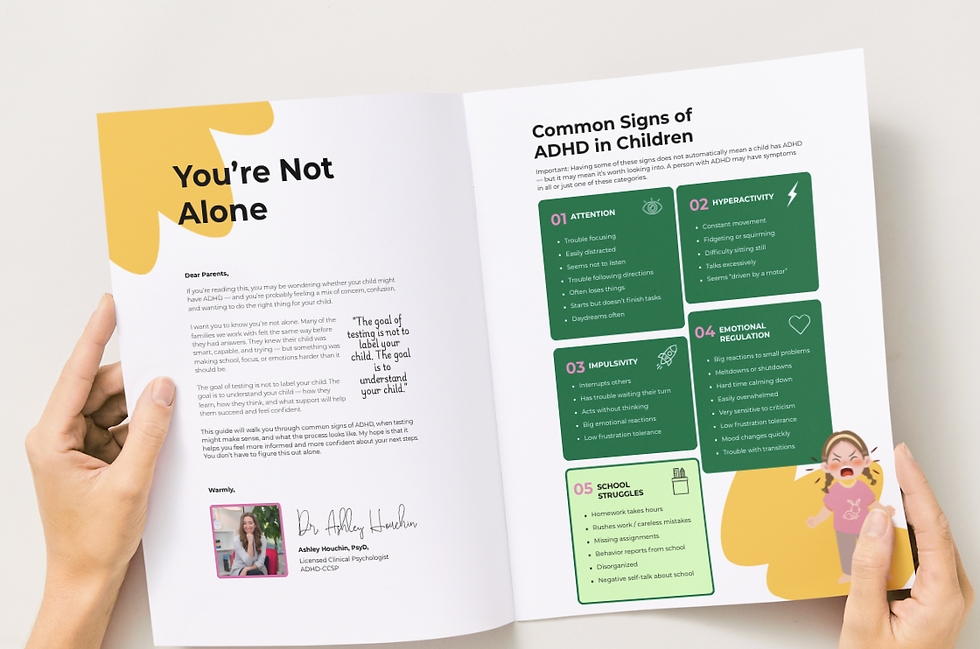
Worried Your Child Might Have ADHD? A Parent’s Guide to Signs, School Struggles, and Testing

The guide was designed to help parents better understand what ADHD can actually look like, how it affects daily life and school performance, and when testing may be worth considering.
ADHD Doesn’t Always Look the Way People Expect
Many people still picture ADHD as a child who is constantly running around or disrupting class.
But ADHD can also look like:
Daydreaming
Emotional outbursts
Forgetfulness
Difficulty following multi-step directions
Avoiding homework
Trouble starting tasks
Low frustration tolerance
Strong intelligence paired with inconsistent performance
Anxiety or low self-esteem
Some children work incredibly hard to mask their struggles during the school day, only to completely fall apart at home.
Others are labeled “lazy,” “unmotivated,” or “not trying,” when they are actually dealing with executive functioning challenges related to ADHD.
School Struggles Are Often One of the First Signs
Parents often seek support because school has become stressful for everyone involved.
You might notice:
Missing assignments
Frequent teacher concerns
Difficulty staying organized
Homework battles every night
Trouble remembering instructions
Emotional reactions to schoolwork
Declining confidence
One of the most important things for families to understand is this: ADHD is not an intelligence issue.
Many children with ADHD are highly capable. The challenge is often with attention regulation, organization, working memory, and task management.
Without support, children may begin to believe something is “wrong” with them when they simply need a different approach and better understanding.
How ADHD Testing Can Help
A comprehensive ADHD evaluation can provide clarity about what’s going on beneath the surface.
Testing may help:
Determine whether ADHD is present
Rule out other concerns that can look similar
Identify strengths and weaknesses
Support school accommodations
Guide treatment and support recommendations
Reduce frustration and uncertainty for families
For many parents, finally understanding why things have been hard brings an enormous sense of relief.
What’s Inside the Free ADHD Parent Guide?
Our free guide covers:
✔ Common signs of ADHD in children
✔ How symptoms can look different from child to child
✔ ADHD and school struggles
✔ When to seek professional support
✔ What ADHD testing involves
✔ How evaluations help families move forward
✔ Practical next steps for parents
It’s designed to be easy to read, supportive, and helpful whether you’re just beginning to ask questions or actively considering testing.
Created by an ADHD Expert and Parent
The guide was created by Dr. Ashley Houchin, our founder and a licensed clinical psychologist who specializes in ADHD evaluation and support for children, teens, and families.
Dr. Houchin is an ADHD-Certified Clinical Services Provider (ADHD-CCSP) and also a parent of a child with ADHD, bringing both professional expertise and personal understanding to the families she serves.
Download the Free Guide
If you’re worried your child might have ADHD, you do not have to navigate the uncertainty alone. Click the button below to download your free guide.


Comments